Course Overview
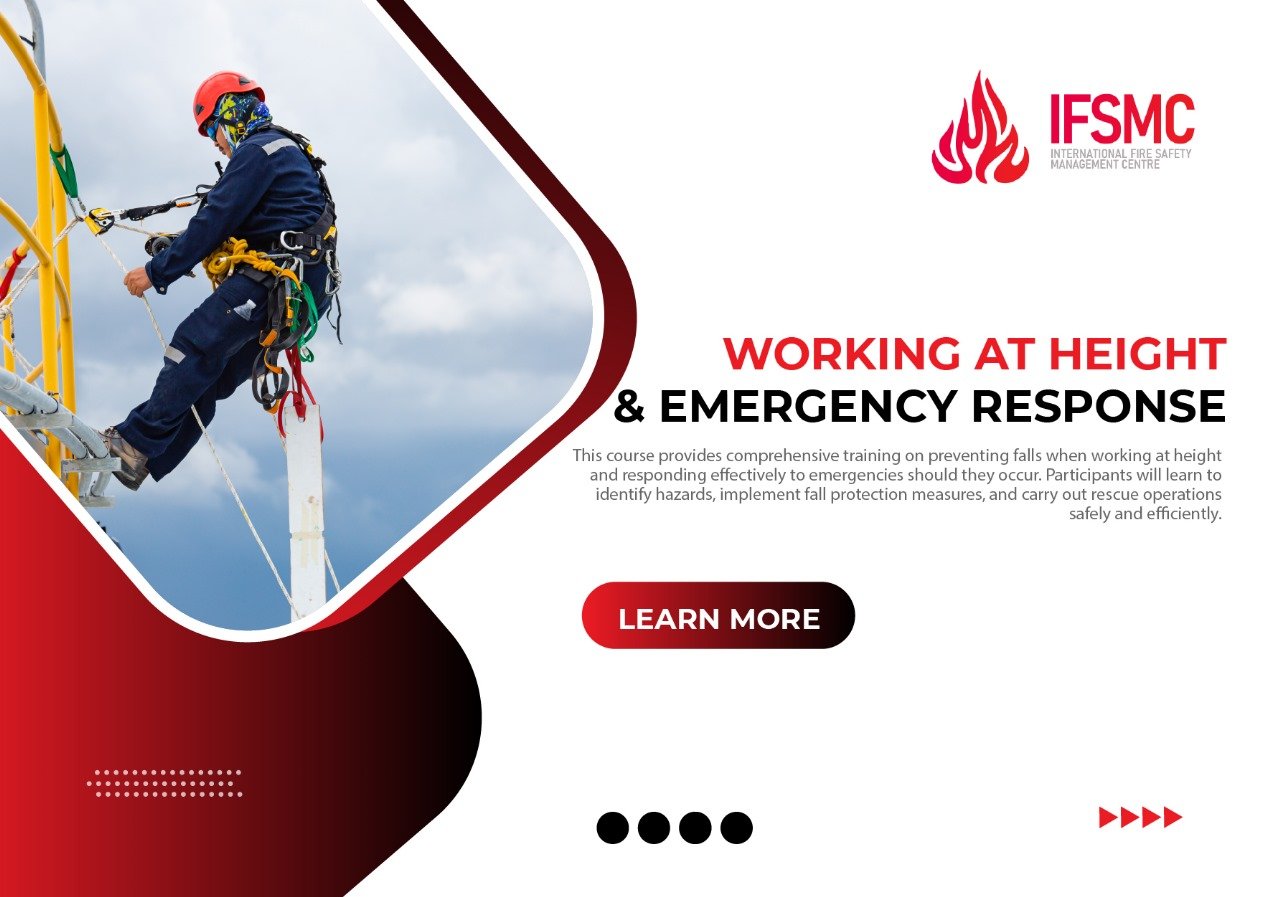
This course provides comprehensive training on preventing falls when working at height and responding effectively to emergencies should they occur. Participants will learn to identify hazards, implement fall protection measures, and carry out rescue operations safely and efficiently. The course combines theoretical knowledge with hands-on exercises, making it suitable for workers, supervisors, and safety officers engaged in elevated work environments.
Learning Objectives
By the end of this course, participants will be able to:
- Explain legal requirements, international standards, and employer responsibilities for working at height.
- Recognize common hazards and implement effective risk control measures.
- Correctly select, inspect, and use fall protection and rescue equipment.
- Develop and follow safe work procedures, including permit-to-work systems.
- Prepare and implement emergency response and rescue plans specific to work-at-height scenarios.
- Demonstrate practical skills in fall arrest, casualty recovery, and post-incident procedures.
Course Outline
- Introduction to Working at Height
- Definitions and common hazards
- Statistics and real-life incidents
- Legislation and Standards
- OSHA requirements, ISO 45001, and UK HSE guidelines
- Responsibilities of employers and employees
- Hazard Identification and Risk Assessment
- Assessing work environments
- Hierarchy of control measures
- Fall Protection Systems and Equipment
- PPE: harnesses, lanyards, lifelines, SRLs
- Anchor points and guardrail systems
- Inspection, storage, and maintenance
- Safe Working Procedures
- Ladders, scaffolds, and mobile platforms
- Permit-to-work systems
- Weather, environmental, and access considerations
- Emergency Response Principles
- Types of emergencies at height
- First response priorities (ABC of rescue: Airway, Breathing, Circulation)
- Communication during emergencies
- Rescue Planning and Techniques
- Fall victim rescue methods (self-rescue, assisted rescue, mechanical systems)
- Rescue equipment selection and use
- Minimizing suspension trauma during rescue
- Practical Demonstration and Drills
- Harness fitting and pre-use checks
- Simulated fall arrest and casualty recovery scenarios
- Coordinating emergency teams
- Case Studies and Best Practices
- Review of incident investigations
- Preventive measures and lessons learned